Sunday, August 29, 2010

Edvard Munch: Sex and Death at the National Gallery


On view through October 31 are over 60 prints by the troubled Norwegian virtuoso (1863-1944), who obsessed over sick children, jealousy, death, insanity, and the fair sex. Affected by the passing of his sisters and mother, Munch saw women as mediums of agony and death. His work incorporates ghostly women figures that expose his inner fixation on these subjects. He is able to seamlessly connect subject matter that is so seemingly disconnected (girls, mortality, anxiety). Haunted. Dark. Seductive. Munch would often revisit previous works, changing the colors and cropping some, so for many of his pieces there is more than one version.    


Above:  The Kiss, 1895. Etching, open bite, drypoint and aquatint on card.


My picks from the show:


The Scream, 1895. Lithograph on tan card. 


Vampire II, 1895/1896-1902. Lithograph in black in sawn woodblock piece in red with hand coloring on China paper.


Toward the Forest I, 1897 c/. 1913. Color woodblock, from two woodblocks, sawn into three pieces, in blue, green, and yellow beige on wove paper.  


Toward the Forest I, 1897/1913-1915. Color woodcut, from two woodblocks, one sawn into three pieces, in green, pink, yellow, black, chartreuse, and violet on imitation vellum paper.


Toward the Forest II, 1915. Color woodcut, from one woodblock sawn into three pieces, in brick red, black, olive green, geenish yellow, and violet on imitation vellum paper.


Madonna, 1895/96. Lithograph in black with hand coloring on green card.


Madonna, 1895/1902. Color lithograph in black and red, and sawn woodblock or stencil in blue on China paper.  
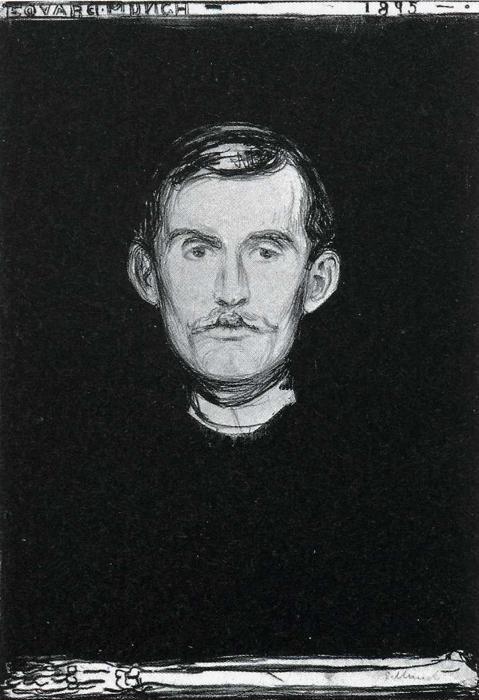


Self-Portrait with Skeleton Arm, 1895. Lithograph.


Waves of Love, 1896. Lithograph in black with hand coloring on thick whitish China paper.


Ashes I, 1894. Oil on canvas.

Monday, July 5, 2010

Beat Memories: The Photographs of Allen Ginsberg


At the National Gallery through September 16th hang 79 of American poet Allen Ginsberg's photographs from the ‘50s-‘80s, including his popular "drugstore" prints. Ginsberg was not a serious photographer, but began taking pictures of friends with a second-hand Kodak camera. He ended up finding the pictures many years later, impressed by what someone who was at the time an amateur had produced. They are autobiographical; just pictures of himself, some family and colleagues, including Bob Dylan, Jack Kerouac, and William Burroughs to name a few. The photos mostly document Ginsberg’s young life as an iconoclast in New York City’s East Village, before he became a published author, or gave rise to a generation of beats. Below nearly every image is Ginsberg's own handwritten inscription, his poetic interpretations of each moment. He effortlessly captures interest in every picture--his talent for photography is plain undeniable. Intimate and intuitive.


My Beat Memories picks: 


Inscription:  Jack Kerouac wandering along East 7th Street after visiting Burroughs at our pad, passing statue of Congressman Samuel "Sunset" Cox, "The Letter-Carrier's Friend" in Tompkins Square toward corner of Avenue A, Lower East Side; he's making a Dostoyevsky mad-face or Russian basso be-bop Om, first walking around the neighborhood, then involved with The Subterraneans, pencils & notebook in wool shirt-pockets, Fall 1953, Manhattan.

1953
gelatin silver print, printed 1984–1997
image: 29.2 x 45.1 cm (11 1/2 x 17 3/4 in)


Inscription:  Neal Cassady and his love of that year the star-cross'd Natalie Jackson conscious of their rôles in Market Street Eternity: Cassady had been prototype for Jack Kerouac's 1950 On the Road saga hero Dean Moriarty, as later in 1960's he'd taken the driver's wheel of Ken Kesey's psychedelic-era day-glo painted Merry Prankster crosscountry bus "Further." Neal's illuminated American automobile mania, "unspeakably enthusiastic" friendship & erotic energy had already written his name in brightlit signs of our literary imaginations before movies were made imitating his charm. That's why we stopped under the marquee to fix the passing hand on the watch, San Francisco, maybe March 1955.

1955
gelatin silver print, printed 1984–1997
image: 24.9 x 38 cm (9 7/8 x 14 7/8 in)


Inscription:  Francesco Clemente looking over hand-script album with new poem I'd written out for his Blake-inspired watercolor illuminations, we'd done two books before; entrance corner of his loft overlooking Great Jones Street Manhattan, October 1984. He liked this picture.

1984
gelatin silver print, printed 1984–1997
image: 40.4 x 27 cm (15 7/8 x 10 5/8 in)


Inscription:  I sat for decades at morning breakfast tea looking out my kitchen window, one day recognized my own world the familiar background, a giant wet brick-walled undersea Atlantis garden, waving ailanthus ("stinkweed") "Trees of Heaven," with chimney pots along Avenue A topped by Stuyvesant Town apartments' upper floors two blocks distant on 14th Street, I focus'd on the raindrops along the clothesline. "Things are symbols of themselves," said Chögyam Trungpa Rinpoche. New York City August 18, 1984

1984
gelatin silver print, printed 1984–1997
image: 42 x 28 cm (16 1/2 x 11 in)


Inscription:  Myself seen by William Burroughs, Kodak Retina new-bought 2'd hand from Bowery hock-shop, our apartment roof Lower East Side between Avenues B & C, Tompkins Park trees under new antennae. Alan Ansen, Gregory Corso & Jack Kerouac visited, Jack's The Subterraneans records much of the scene, Burroughs & I edited letter-manuscripts he'd sent from Mexico & South America, Alene Lee ("Mardou Fox" of The Subterraneans) typed final drafts. Neighborhood was heavily Polish & Ukranian, some artists, junkies, medical students, cheap restaurants like "Leshkos" corner 7th & A, rent was only ¼ of my monthly $120 wage as newspaper copyboy. Time of "The Green Automobile" poem to Cassady, Fall 1953.

1953
gelatin silver print, printed 1984–1997
image: 28.6 x 43.8 cm (11 1/4 x 17 1/4 in)

Monday, May 10, 2010

Georgia O'Keeffe: Abstraction


I had the pleasure of spending Saturday afternoon with Georgia O'Keeffe. She is much more than the vagina flowers she’s known for (she claimed these paintings weren't sparked by what critics assumed was latent lesbianism, nor were they caused by her assumed sexual frustration). On view at the Phillips Collection are over 100 of her bright paintings and drawings, including her earlier and more known pieces. Also included are photographs of O'Keeffe taken by her husband, Alfred Stieglitz. Some of my favorites from Abstraction are below. Above: Jack-in-the-Pulpit No. IV, 1930 oil on canvas (40 x 30 in). This image headed the gallery's advertisements for the exhibition. A collection of vivid, colorful, sensual and imaginative pieces, mostly inspired from desert life.   


My picks from Abstraction:


Music, Pink and Blue No. II, 1918. Oil on canvas, 35 x 29 1/8 in.


Sky Above Clouds III / Above the Clouds III, 1963. Oil on canvas, 48 x 84 in.


Georgia O'Keeffe: A Portrait, 1918. Photograph by Alfred Stieglitz.


Black Door with Red, 1954. Oil on canvas, 48 x 84 in.


Pelvis Series - Red with Yellow, 1945. Oil on canvas, 36 x 48 in.


Ram's Skull with Brown Leaves, 1936. Oil on canvas, 30 x 36 in.


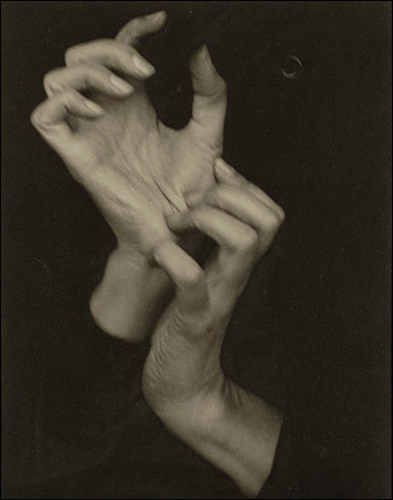
Georgia O'Keeffe (Hands), 1918. Photograph by Alfred Stieglitz.

Wednesday, May 5, 2010

Sunil Gupta's New Pre-Raphaelites


The New Pre-Raphaelites: 12 ink-jet printed photographs of cross-dressing Indian men and women, who imitate the classic poses of 19th-century sitters, on display at the Grosvenor Gallery (London). Gupta's subjects are all very obviously gay. Homosexuality has been a recurrent theme in Gupta's work for the last 30 years. The Grosvenor Gallery also featured his series Mr. Malhotra’s Party in 2007, the subject of which is again Indian gays and lesbians, who "stare defiantly into the camera.” This motif reminds me of the work of African-American abstract expressionist artists from the '60s and '70s, who centered upon similar themes, but about Blacks. Gupta’s photos are brimming with self-avowal, sexuality, culture, ethnicity, and color. He’s put an innovative twist on the art of the 19th century greats (many of whose sexually has or had been speculated over at one time or another) in a way that’s relevant in the 21st century. 


Featured above: The New Pre-Raphaelites 8    


More of my favorites from The New Pre-Rapaelites--13 series:


The New Pre-Raphaelites 6


The New Pre-Raphaelites 4


The New Pre-Raphaelites 11


The New Pre-Raphaelites 12


The New Pre-Raphaelites 5


The New Pre-Raphaelites 2